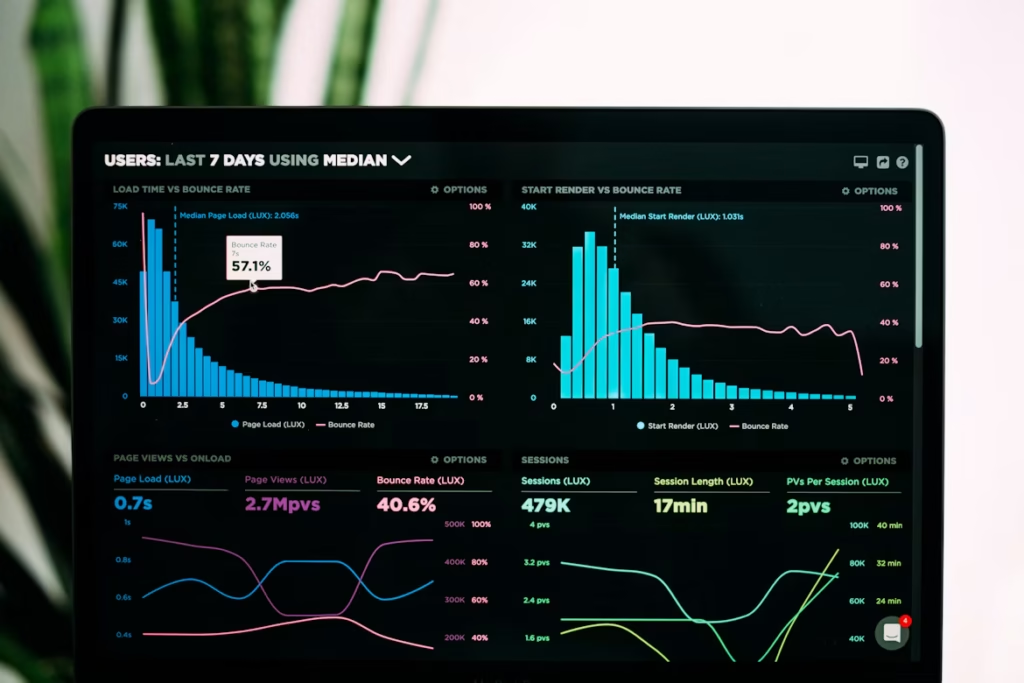
SEO reporting should explain what changed, what the evidence supports, and which business decision comes next. A useful report connects search visibility with relevant visits and qualified outcomes while keeping those measures distinct. It does not treat a larger traffic total as automatic proof of a better investment.
Agree on the report’s purpose before selecting charts. A business owner deciding next month’s priorities needs a clear interpretation and action plan, with access to the supporting detail when needed.

Define the layers in your SEO reporting
Search visibility describes how the site appears in search. Website activity describes what measured visitors do after arrival. Business outcomes describe suitable enquiries, sales opportunities, or other agreed results. The layers are related, but their totals will not necessarily match.
Google’s Search Console documentation defines clicks, impressions, click-through rate, and average position. Keep those definitions with the report. A search click is not the same measure as an analytics session, and average position is not a fixed rank every customer sees.
Omnicom’s Flywheel report announcement emphasizes connecting fragmented activity to business outcomes. For a smaller business, that means explaining how the selected search measures relate to an actual commercial question.
Keep the comparison consistent
Record the data source, reporting dates, filters, geographic scope, and known measurement changes. Compare equivalent periods where possible and explain seasonal differences. A short month and a long month are not identical exposure periods.
Separate relevant service pages from unrelated traffic growth. Where the available query data allows, distinguish branded searches from broader discovery, while acknowledging incomplete or ambiguous classifications. Do not imply that every visitor arrived because of the latest SEO work.
Include a change log for implemented work. A recommendation is not an implementation, and an implementation is not a verified outcome. Name delays or dependencies that affect the interpretation.
Read a hypothetical result without hiding the counts
Suppose a service page receives 400 measured organic sessions and 12 enquiries in one period, then 600 sessions and 15 enquiries in another. The enquiry rate changes from 3% to 2.5%, even though the enquiry count increases.
If four enquiries in the first period and three in the second meet the agreed qualification criteria, the commercial picture becomes less encouraging. The numbers warrant checking audience relevance, qualification consistency, and follow-up. They do not establish the cause by themselves.
This example is illustrative, not a Blakk Brikk client result. Showing counts, rates, and qualification together helps prevent a report from selecting whichever percentage looks most favorable.
Explain discrepancies and uncertainty
Search and website tools use different definitions and collection methods. Missing consent, implementation faults, attribution choices, and reporting filters can affect what is recorded. Investigate material discrepancies rather than forcing tools to agree through selective filtering.
A reported zero may mean no measured activity, incomplete setup, or unavailable data depending on the system. State which interpretation is supported. Use “not measured” when that is the truth, rather than converting an unknown into a performance claim.
Avoid diagnosing a ranking change from one isolated search. If a position tool is used, record its query set, location, device, and method. Its result is an observation under those conditions.
Finish with a decision someone can act on
For each priority, state the observation, interpretation, proposed action, owner, and verification plan. For example, several unsuitable enquiries might justify clearer service eligibility, followed by a review of enquiry quality. It does not automatically justify producing more articles.
Keep reporting proportional to the decision. A concise narrative with a few relevant measures can be more useful than an unexplained dashboard. Retain supporting detail so the interpretation can be checked.
When assessing a provider, use the existing SEO pricing guide to consider scope and reporting together. Blakk Brikk’s SEO services can be discussed against agreed outcomes and measurement limits. Bring a current report and the decision it needs to support.
Editorial note on SEO reporting: This article was researched and drafted with AI assistance. Cited research and illustrative examples are identified in the text.